Showing posts with label derriere equestrian. Show all posts

Tuesday, 19 April 2022

Derriere products are an essential on the holiday packing list!

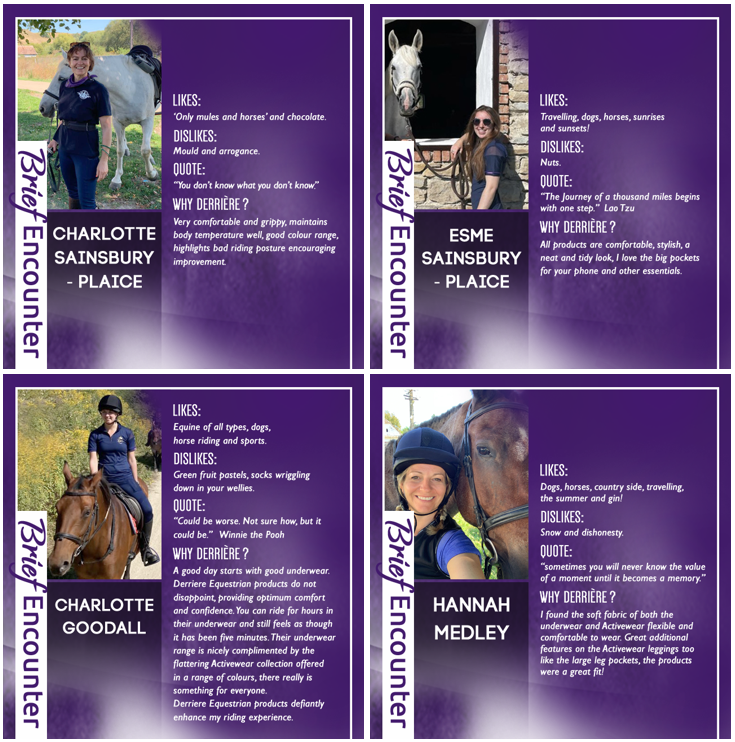
What happened when Derriere Equestrian’s sales, customer care and marketing coordinator Charlotte Goodall took a trip to Romania in her Derrieres?

I’ve always wanted to go on a riding holiday abroad and having previously experienced some of the UK trips offered by The World on Horseback, their organised trip to Romania seemed like a fantastic opportunity. I was not disappointed. Traveling back in time to explore the unspoilt, unfenced bucolic ambience of Transylvania was a truly staggering experience.


Our itinerary consisted of 4 days in the saddle through never-ending countryside, woodland, and traditional villages, passing herds of goats, cows, sheep whilst being cautious of meeting the black bears (thankfully passing fresh prints in the soft ground was as close as we got!) It is safe to say the experience wouldn’t have been the same if it wasn’t for my Derriere Equestrian® underwear!

Averaging about 20km per day, experiencing nothing short of ultimate comfort in the saddle enhanced my ridden experience, both feeling good and looking stylish allowed me to further soak up the sun, relish the beautiful scenery, trusted horses, and charming company. 


Our days included stops at visiting beautiful sights and majestic churches in various local villages.  The food definition of field to fork,  elegantly presented, traditional, organic, and sustainably sourced, every mealtime was a delight, definitely keeping standards as high as the overall riding experience was.

The Derriere Equestrian® Performance Padded Panty combines science with style, scientifically designed for the equestrian sport, eradicating discomfort, and reducing concussion. The use of high quality Italian breathable, bacteriostatic and moisture wicking fabric ensures a feeling of both optimum health, hygiene, and comfort.


The new bespoke Derriere Equestrian Activewear collection pleasantly compliments the equestrian underwear range. They work in harmony together to provide core pieces for your equestrian wardrobe. The technical tops and riding leggings combine high quality, functionality with exceptional comfort. The advanced moisture wicking and temperature regulating properties incorporated into the breathable, quick drying sporting technology fabric encourages high performance whilst providing ultimate comfort and support. The elegant design is flattering to the body and offers a secure yet subtle grip to the saddle. 

I would recommend both the underwear and activewear combination of products as essential to riders of all disciplines.  The Derriere Equestrian Underwear has been designed to eradicate seamlines diminishing the risk of the dreaded VPL. Ensuring discretion and style whilst enabling riders like myself to ride for miles in the saddle with no negative implications.


The World on Horseback provided me with the most mesmerising riding holiday in Transylvania,  the trip assured adventure as well as a feeling of being immersed in culture. Derriere Equestrian® provided me with ultimate confidence and comfort on these rides.


What did the other riders think about riding in their Derrieres? 


Monday, 21 March 2022

Tackling transitions by Derriere Equestrian ambassador Erin Orford

Walk to trot transitions sound so simple, but it is so important to get the foundations right, and these basics must come before all else if you are to progress up the ladder as a successful partnership with your horse! Many horses rush the upward transition, and can hollow out in the downward transition; both should be performed consistently if you want to achieve good marks in a test. The horse shouldn’t anticipate the next move, e.g. you would lose valuable marks in a dressage competition if going from a free walk on a long rein into a rushed jog, rather than a medium walk! 

When schooling, try to establish a soft medium walk; forward but not too fast or rushed! The horse should not lean on you, but should be working into the reins and accepting of the contact - this is your communication line. ‘Sponging’ the reins with your fingers can be used to encourage them to soften rather than pulling or using the reins for your own balance. The horse should keep the momentum going without you having to nag with the leg but you should also be able to use it to influence their body without them blocking against it or rushing forward so they stay between the leg and the rein. (If you use your schooling whip as an adapted leg aid, be sure to use it to back up the softening rein aid, to encourage forward movement.)
Handy halts 
Once you have established a nice walk, as an exercise, ask for a good, square halt. Use your body as a half-halt to shorten the steps, whilst still riding forwards into the halt. One of the most common errors I see is riders stopping from the rein and taking the leg pressure completely off, which would encourage the horse to fall into the halt, and to lean on you. Ride forwards into any transition to keep the horse stepping under and pushing forwards and upwards into the transition, rather than doing it front to back from the rein, resulting in the hind legs being left behind.

The preparation for the halt is the most important part of getting a good halt, so check the horse’s balance and straightness (e.g. are they falling one way or another?), as if they’re crooked and falling one way going into it, this will be how they halt. You should be able to prepare for the halt without the horse anticipating it, so in training, only ask them to actually halt when you have them in the right place during the steps before it. They should step forwards into the halt, and stand in a nice balance, ready to push forwards out of the halt. If they leave a leg behind, always correct them by stepping forwards, rather than backwards. 


Walk-trot transitions 
For a nice upward walk-trot transition, the horse must be walking for himself, so that you can give a light aid to ask them to move up into trot. If you’re having to nag them in the walk, you’re going to have to make even more effort to move up into trot, so think about how much effort you’re having to put in, compared to your horse! Give a light aid and then if they don’t respond, back it up with a quicker leg aid, making sure to reward them when you get the response you want. As in the walk, the horse should trot for themselves without you needing to constantly remind them, so if you have a lazy horse that relies on the leg, your goal is to be able to use less leg, and for them to keep trotting. If you have a hot or sharp horse that runs away from the leg, your goal is to be able to keep your leg on their side a bit more (almost hugging), without them running away from it. You can use your body weight by moving your shoulders slightly forwards (marginally!), to ask for them to move forwards, and by sitting up a bit more, to ask them to wait. 


Trouble shooting 
To check if your horse is truly on the aids, you can set yourself markers to trot or walk at, and then you can see how long it takes your horse to respond, as in a dressage test, you need to have the control to be able to perform a movement or transition right on the marker. You can do transitions both on and off the track to check you have control of their body before during and after the transition, and notice any changes during this. It’s also worth checking your own rider balance and position; it’s easiest for the horse to carry us when we’re in balance, and they want to be directly under our weight. So, if we’re moving all over the place, it makes it more difficult for them to be straight! Once you are able to do these transitions effectively, you can also add in transitions within the pace by riding forwards and then collecting the trot a little, and then forwards again. This will also help to develop the expression within the trot, and allow you to play with the gears; but make sure to start with small changes within the gears before building this up, so that the horse stays soft and supple over the back! 


Downward transitions 
To gain a pleasing downward trot-walk transition, you should go into sitting trot, maintain your forward energy and use your body to ask the horse to start to sit and shorten the trot steps to help their balance, going into the walk. If you need to, you can use the outside rein to give a half halt, but make sure to give it straight after, so that you don’t rely on it to slow down, and you’re not pulling the horse into walk. If they are bracing going into the transition, try to play with slowing the trot down within your trot work, whilst keeping the softness, so that you can keep them in a good balance, and soft during the preparation of the transition. This will allow you to ride forwards into the transition, rather than using the rein to pull them backwards into it. Over time and repetition, this will improve and your horse will get stronger within this, so that he can maintain a good balance and outline throughout. 


What to wear 
When you’re training, the Derriere Equestrian Treviso Training breeches are great breeches to consider. They’re designed to promote optimal comfort and performance, and work in harmony with the Derriere undergarments, ensuring all fabric surfaces come together in a symbiosis that completely eliminates chaffing, abrasions and discomfort! The material content is a comfy mix of cotton, microfibre and elastane. 
All about Erin Orford Derriere Equestrian sponsored rider Erin Orford is one of Britain’s most determined and inspirational dressage riders. A qualified UKCC Level 2 Dressage coach, Erin has her sights set on the Paris 2024 Paralympics and beyond. Visit - www.erinorforddressage.com


Wednesday, 18 August 2021

Antoine Nowakowski – top tips for an effective warm up and cool down


Continuing our recent series of ‘how to’ articles from leading riders, leading dressage competitor and trainer and Derriere ambassador, Frenchman Antoine Nowakowski, shares with us his suggestions for the warm up and cool down stages of flatwork training.


Warm up

Let’s think about what are the practical reasons behind warming up? This phase prepares the horse’s muscles and tissues for work, and can also have a psychological aspect, in terms of preparing the horse mentally. Each horse’s warm up and cool down programme should be tailored to its level of fitness and discipline. Generally speaking, the warm up period is a phase of gentle exercise that stimulates the muscles to safely contract by increasing blood flow; allows synovial joint fluid to lubricate the joints; helps prevent lactic acid build-up by stimulating the circulatory system; and prevents injury caused by strain to tissues, such as tendons and ligaments. Generally I find that horses work best when given around twenty minutes of initial slow work, especially in walk, before they are asked to perform anything taxing.


Warming up and cooling down is fundamental to training! If you are not effective in your warm up, you will be building on tight muscles. The primary purpose of this stage for me is to get blood to the horse’s surface muscles, and warm them up. My golden rule is, never stretch cold muscles; stretching longitudally and laterally comes afterwards, when the muscles are more supple. After this happens, the next stage is to get the horse responding to my aids.


Non-mounted warm up

Ground work can be very beneficial to a horse’s exercise programme. In colder weather you can walk the horse in-hand in the arena for five to ten minutes before mounting. This allows the horse to physically warm up and get used to its surroundings. I would advise only mounting when your horse has relaxed sufficiently. Other ground-based warm-ups include lungeing and long reining, which can help a horse to supple up through his body, begin working from behind and stretch down into a relaxed frame.


Mounted warm up

An important piece of advice is not to neglect the walk in your mounted warm up, especially if you have not done any ground work first. A useful show warm up is often lots of walking - straight lines and lateral work. This relaxes the horse and prepares them for the subsequent work. Warm up is key, as horses working and competing at high levels need to be physically and mentally able to meet the demands of competition.


Cool down

A cooling down period is also vital! At the end of a flatwork session, you could do around five minutes’ worth of ‘long and low’ work, keeping the horse’s concentration by putting in lots of transitions. You can then walk on a loose rein for up to five minutes, or even take him for a walk outside the arena, to cool off.


Comfort and performance

Antoine is French vice-national champion in the 7-year-old division, and recently won the Inter II at the CDI Deauville event in France with Quatergirl, in the pair’s second ever international competition, culminating in their first victory at this level. “If you are a big fan of flatwork training, as I am, then you need to be comfortable in the saddle. I like Derriere riding underwear. Remember that when the rider is comfortable within the saddle, they can move more easily with the horse’s gait. Comfortable underwear and breeches are a must and the Derriere Equestrian range is designed for both men and women; it’s hard to find great riding underwear for men, but I find these products excel at their job, offering exceptional comfort and performance,” he says.


Thursday, 3 June 2021

Catching up with Bex Mason

We find showjumper Bex Mason in a positive frame of mind, as she updates us on her horses’ plans, and embraces the power of flexing your goals!

It has been a hectic period, as sadly my top rides Vancurtis, Pure Pleasure and Korenosa are all out of action with injury, at the moment.


Bex Mason & Vancurtis, show jumpers, horses, horse riding

It’s changed our plans dramatically – I do tend to build my competitive schedule for the year based around the more experienced horses – I can then pop the young horses’ weekday training shows in the schedule around the older ones’ events. 

But the injuries have thrown spanner in the works! This is horses, though – and I have been so lucky not to have experienced a great deal of injury issues in the years I have been competing. Luckily these are not old horses, and the time off gives them a chance to heal, iron out any other niggles or physical issues, and grow into themselves, at least in the case of Korenosa.

show jumpers, horses, horse riding, bex mason, showjumper


Finding the positives

I am finding the positives, and am excited to be concentrating on the younger ones.

For example, we went to Bicton Arena recently, and took four youngsters. I went with the goal of just jumping some clears, but each horse was competitive, with all of them placed most days. It is only a few years away until the youngsters are out jumping bigger things. I like to keep looking onwards and upwards!

A big goal for me was to jump a world ranking class, and even with the altered schedules, I still like to work backwards – I am being flexible with my goals, but still with an eye on working backwards from a big event when the horses are sound again, so consistently jumping 1.40’s in a big arena. 

My main goal for now is to continue progressing the youngsters quietly, and aim for British Novice and Discovery second rounds – it’s nice for them to get experience at different arenas. Because I want to ideally keep the youngsters that I produce, I am looking into syndication. I do have half shares in Vancurtis, Pure Pleasure and Korenosa, and having syndicated owners would help with our running costs! The syndication model is quite new for us, but I think it has many benefits for the owners and the rider, who gets to keep the ride on a horse they’ve invested time in.


show jumpers, horses, horse riding, bex mason,

Busy business plans

I am also developing a busines plan for the stables – I need my arena extended! We have been here for ten years, and it’s time for an upgrade. And I am currently focussing more on teaching and developing my clinics. I got more into teaching during the 2020 lockdown, and I love it – I like seeing client’s results and progress. It’s very rewarding, and I like to give something back and serve people. I have lots of projects I can get on with now that I have a little more time – I have over thirty training videos to edit and do voice overs for! There’s so many more elements to doing what I do, in addition to ‘just riding’, which makes it a really interesting profession.


show jumpers, horses, horse riding, show jumping, bex mason,

Powerful positivity

I think it’s important to be positive and live in the moment. It’s a mindset that serves me well. I listen to a lot of self growth podcasts, and like to maintain a good mental wellness routine. I for example start the day with gratitude affirmations, meditation, some body stretching, and some crazy music to get me into a positive emotional state. When I got particularly busy, I neglected this regime, and I could feel the negative results of it – I am back into it after a pause now though, and find that keeping on top of mental wellbeing is really the key to so many things – not least when it comes to dealing with setbacks and horsey challenges!

Bex has worked for many years breaking in horses and competing at an international level and specialises in producing competition horses. “I find myself expressing love for my Derrieres daily,” Bex says of the underwear range. “I openly discuss the results and versatility of the products, whether it’s to customers at my yard, or fellow competitors at shows; I don’t even realise I’m doing it - these pants change riders’ lives!”

Please keep an eye on Bex's social pages for details of forthcoming clinics - Insta: @bexmasonsj 

www.facebook.com/bexmasonsj


Shop the Derriere Equestrian underwear range today:
www.derriereequestrian.com 

Thursday, 6 May 2021

Beating bacterial bugs with bacteriostasis

Did you know that when you buy a Derriere Equestrian undergarment boasting bacteriostatic properties in the gusset, you’re paying for a high-quality, superior product that can actually prevent the growth of bacteria, caused by sweat? The compound on the clothing fibres keeps bacteria in the stationary phase of growth, so they can’t flourish, meaning that your nether regions are being not only comforted, but also protected from a potentially harmful bacterial processes.


Sweaty-betty

We sweat when our glands release sweat onto the skin; it’s a simple and clever process that arises when our body temperature rises due to exercise and heat - sweating simply and effectively helps us regulate our internal body temperature. When the sweat mingles with skin bacteria (and the more moist the conditions, the more accelerated the process), the bacteria multiply, and associated odours may also be released. There isn’t a big heath risk associated with this process for most people, although it can lead to an increased risk of yeast infections, and could be more dangerous if there was a break in the skin (for example from chaffing), and harmful pathogens were to enter the bloodstream, it can however be uncomfortable so the correct riding underwear is a must.


Beating bacterial bugs

Derriere Equestrian’s exclusive riding underwear fabric is quick drying and expels moisture, which helps reduce bacterial growth. The bacteriostatic polymer that we use within the manufacturing process bonds with the fabric, cleverly targets the molecular integrity of bacterial cell membranes, to inhibit bacterial growth.


Importantly, bacteriostatic compounds act by inhibiting the growth of bacteria while preserving the normal bacterial skin flora, so (unlike antibacterial materials), our fabric does not eradicate normal bacteria skin flora (known collectively as skin microbiome). The skin actually has an immune response, and individual, microscopic receptors cleverly recognise ‘bad’ bugs, and form a defence against harmful pathogens (e.g. those created via sweat and held in moist areas such as close-fitting fabrics.). So, bacteriostatic clothing can be preferential to antibacterial items, because the skin microbiome is maintained.


Your nethers will thank you

The Derriere Equestrian Performance Panty (DEPP) is a hero product from the range, and is a perennial favourite with horse riders looking for quality, comfortable riding-wear. It’s designed to eradicate seamlines and eliminate chaffing using bonded seams, and is made from a blend Polyamide and Elastane, resulting in a soft, supportive undergarment with the performance stretch needed for equestrian sports like dressage, show jumping, endurance and eventing.

If you’re looking for riding underwear that offers comfort and protection, then bacteriostasis is probably not top of your list when it comes to researching the underwear brand for you! But the fact you’re also protecting your body is another reason to choose Derriere Equestrian riding underwear; your ‘nethers’ will thank you! For more information on the science and technology behind Derriere Equestrian underwear, click here

Shop the Derriere range today! 
www.derriereequestrian.com  


Friday, 23 April 2021

Summer riding attire


Why choose riding clothing that has skin thermoregulation properties?

With summer approaching, the ambient temperature will be very changeable – this means the inevitable issue of becoming hot and sweaty when riding – something all riders are familiar with! Our arenas are commonly filled with ladies riding in vest tops in summer, to increase air-flow and reduce excessive warmth from riding clothing.


Maintaining our body temperature

Our skin, essentially one inter-connected organ, is very practiced at maintaining our body temperature within suitable limits; as best it can, at least. As the sun becomes hotter, the skin’s immense blood supply helps regulate temperature - blood vessels in the dermis, the middle layer of the skin, dilate to allow for heat loss, and constrict to retain heat.


With its large surface area, our skin plays an important role in body thermoregulation. As we ride and increase our metabolic and physical processes – for example, riding the faster gaits, or performing a showjumping round – our body generates heat. When it becomes excessive, the body cleverly vasodilates the skin’s blood vessels, to start the cooling process. A further key process is sweating, which roughly speaking begins when the body temperature rises above 37 C. As drops of sweat form on and then evaporate from our skin surface, they take body heat away with them. Another clever process is convection, whereby air circulation close to the skin allows heat to be dissipated.


Why wicking horse riding clothing is hot to trot!

Let’s look a little at what those little vest tops are achieving, when you’re riding – or any cotton based T shirt or underwear, for that matter. Because cotton is a natural fibre, it absorbs moisture, drawing it away from the skin – but what’s actually preferable is a wicking material. With a cotton top or underwear, the sweat just stays on the material - it doesn’t get drawn away from your skin and isn’t moisture-wicking. A technical material designed for exercise helps dry sweat faster by pulling the sweat away from the skin, out of the clothing, and into the environment. This allows for the cooling process of evaporation. If the top or underwear is tight fitting as well as being less breathable, as most are, convection, whereby air circulation allows heat to be dissipated, can’t take place so efficiently. Another side effect is that unpleasant build-up of perspiration, and the ensuing smell and discomfort!


horse riding leggings, riding leggings, sports leggings, horse riding breeches, riding breeches, breecheshorse riding leggings, riding leggings, sports leggings, horse riding breeches, riding breeches, breecheshorse riding leggings, riding leggings, sports leggings, horse riding breeches, riding breeches, breeches, competition breeches


                  riding top, horse riding tops, equestrian top, sports top       riding top, horse riding tops, equestrian top, sports top

Derriere Equestrian’s new Activewear range includes new horse riding sports tops and leggings boasting carefully positioned mesh areas (under the arms, over the shoulder and thighs and across the back and waist), wicking away moisture to keep you dry when the heat is on. The technical material is made from wicking fibres that allow skin thermoregulation to not only keep you comfortable in the saddle, but also keep the skin more healthy. You may be tempted to ride your horse in a vest-top to keep cool, but as we know from the above, if they are not made with exercise in mind, they are not the best choice. There is also the obvious sun damage and sun burn to consider too – the new Derriere Equestrian Activewear sports tops boast high-neck collars, to protect you from the undesirable effects of the sun (and look fantastic, of course!).


Derriere’s underwear range is too made from exercise specific, sports technology fabric to ensure advanced moisture wicking to keep riders cool and dry in the saddle.


Ask your local Derriere stockist or visit www.derriereequestrian.com to see the range – your skin will thank you!


Thursday, 8 April 2021

Getting to know dressage rider Erin Orford

 We asked para-dressage star Erin Orford to share a favourite flatwork exercise, and also asked her a selection of burning questions, from advice to advice for her younger self.


Erin Orford, dressage, para rider, equestrian, para equestrian rider, para dressage, dressage horse

Can you share a simple exercise to help with a specific rider issue?

“A great one is to Find Your Centre. Many of our daily activities (mucking out, driving, sweeping etc) put more strain on one side of our body, or require more rotation to one side than the other. Often, they'll be completed by our dominant and more natural side automatically, or in some cases (like driving), you have no choice in the matter,” Erin explains.

“This can impact the symmetry of the rider and how we sit in the saddle, but also how far we are able to rotate each way, which may affect what we perceive to be the centre, when we're sat in the saddle,” she continues. “When standing with your feet hip-width apart, or sitting on a chair, have a play with how far you can rotate your body each way, and use a mirror to see if what you feel matches what you see, to find out what is comfortable, and whether there is a difference in your range of movement. Ideally, your range of movement should be the same each way,” Erin advises. “If this is not the case, it may affect what you feel is your 'centre', both off horse, and when you are sat in the saddle.”


Erin Orford, dressage, para rider, equestrian, para equestrian rider, para dressage, dressage horse
Which is your most memorable horse and why?

“All of the horses I've been lucky enough to ride have taught me something and helped to make me the rider I am today.”


What’s your best piece of advice, and why?

“Always be ready - I was first reserve for Team GB for three different years, and it's the hardest role, but I'd never want to regret that I could have done more. It came in handy in 2017, when I got called up at the last minute to make my championship debut, and we came back with Team Gold and Individual Bronze!”


Which person do you look up to today in equestrianism and why?

“I admire anyone who is working in the equestrian industry; it's not all about the medals and the winning, but the small successes too - it takes a lot of hard work and resilience to keep working towards your goals.”


What’s your ultimate riding or training goal?

“One day I would love to ride at Grand Prix; until then my goal is PSG! I could do the movements, but never all on the same horse!”


Erin Orford, dressage, para rider, equestrian, para equestrian rider, para dressage, dressage horse

What’s your biggest regret?

“Not taking enough time to enjoy the achievements – often, you’re so busy moving onto the next thing, you don't appreciate what you've done; so that's been one of my goals for this year.”


What would you’d tell your younger/teenage self?

“Everything happens for a reason, so learn from it but never give up.”


What’s the horse you would like to have ridden?

“I have so many! Valegro and Uthopia seem like obvious answers, but also Helen Langehanenberg's Damon Hill.”


Who would be your ideal dinner party guests?

“Michael McIntyre, Chris Hoy and James Corden.”


What will you be doing in 20 years’ time?

“Hopefully still riding and teaching, enjoying competing, and helping others to enjoy their horses too,” Erin concludes.


Visit Erin’s Facebook page to follow her journey - https://www.facebook.com/EOrfordDressage

Monday, 1 March 2021

The changing face of riding trousers – from twill to athleisure

When many of us learned to ride, you had a very limited choice of riding apparel. Black or beige jodhs with cuffed ankles were hardly the stuff of dreams, and adults especially were unlikely to proudly show off their riding-wear on the school run, or at the shops!


Just jodhs

Jodhpurs have always been very practical, long trousers; relatively snug from the calf to the ankle, usually with reinforced fabric at the calf and knee, and initially looser material at the thigh. Designed by and for men, and named after Jodhpur city in western India, the twill riding garments were first made for military riding in the late 1800s, and were then adopted for polo. Ladies began wearing jodhpurs during the 1920s, as they shifted away from riding side-saddle, and began riding astride; once females became involved in the jodhpur trend, they realised that the attire needed to become a lot more fashionable!  One of the first high-profile women to adopt the wearing of jodhpurs was Coco Chanel. She transformed the ‘practical’ jodhpur into a fashion statement, both on and off the horse.


Brilliant breeches

The more closely fitting (and shorter, calf-length) breeches can also be traced back to cavalry soldiers, notably in Poland, but also have their roots in the long under-trousers that 19th century male children and adults would wear from the age of around seven, whereupon they were deemed as having been ‘breeched’. (The alternative pronunciation and spelling ‘britches’ dates from the 17th century, when it referred to any trousers or long pants.) Around the time that Coco Chanel was converting women to the jodhpur, knickerbocker breeches and ‘plus fours’ were becoming popular in the UK, both fastening below the knee. (Plus fours very specifically fastening four inches below the knee!)


A form-fitting revolution

Lower riding attire rumbled along for many years without any special innovations, until the revolutionary Spandex and associated Elastane products like Lycra were developed in the 1950s and 60s. (Spandex is an anagram of the word expands, which is seemingly where the name comes from). Today, imagine any close fitting garment without Lycra (including swimwear) – what did we ever do without it?


Stretchy materials didn’t influence discipline-specific sportswear for a while, however – keep-fit ladies embraced close-fitting stretchy leotards in the 1970s, but it would take several more decades to reach equestrian’s style wardrobe, in the wider manufacturing sense.


Derriere Equestrian’s breeches

As breeches became more comfortable under long boots (losing the itchy Velcro fastenings), they began to take over the humble jodhpur for not just competition riders, but also for enthusiastic amateurs. Derriere Equestrian’s breeches are a fine example of modern, durable and comfortable riding trousers that boast a blend of cotton, microfibre and Elastane. The length of breeches has extended over the years, as manufacturers have developed close-fitting cuff systems (no more bunched up material at the calves!); the Derriere Flexi Cuff System provides a seamless, flexible design for ultimate support of the rider’s lower limb musculature.


Equestrian Competition Breeches, riding breeches, horse riding breeches, breeches, equine competition wear
 

Athleisure

Even in the early and mid 2010s, few riders would be seen dead in ‘pull on’ riding trousers; the available options were still baggy, without the snug-fitting waistband seen on today’s riding leggings. The early riding tights were not flattering or supportive for most female shapes! Yet today, ‘athleisure’ is increasingly popular, seeing inter-sport cross-over products that make perfect sense for the busy 21st century rider. Athleisure is commonly accepted as all day attire – no need to get changed after your fitness class or riding session! Hence, we’re so excited to announce the imminent launch of the Derriere Activewear Leggings. These are form-fitting, supportive and comfortable, utilising the highest quality of breathable fabrics, designs and workmanship to offer superior comfort, support and style. The high stretch fabric is also wicking – ideal for warm weather riding. There’s choice between three colours and two designs, one featuring a full silicon seat and one with silicon knee grips.


riding leggings, riding tights, horse riding, rider wear, horse riding fashion, riding fashion, equine leggings, equestrian wear riding leggings, riding tights, horse riding, rider wear, horse riding fashion, riding fashion, equine leggings, equestrian wear

With lower riding attire having reached the ultimate status of comfortable, smart and functional, today’s riders really can have it all, and proudly wear their riding leggings both in and out of the saddle. 


The Derriere Equestrian Activewear Range will be available from the end of March with pre-orders taken a couple of weeks before. Keep an eye on the Facebook page for more updates. 


Shop the current Derriere Equestrian range online:
www.derriereequestrian.com


Friday, 13 November 2020

The Perfect Pelvic Tilt


Derriere Equestrian ambassador and UKCC Level 2 Dressage coach, Erin Orford, explains how achieving the perfect pelvic tilt can improve rider effectiveness.

Perfecting your position

We asked Erin to share some wisdom on the subject of getting the correct pelvic position when you’re schooling: “When I am working with my flatwork clients, one of the key issues that does crop up is how we use our pelvis, and how this translates to effectively sitting to a trot,” Erin explains. “Most elite dressage riders have very 'mobile' and intuitive seats; for example, when riding effectively, most of the time you will have a very relaxed and mobile spine, quite neutrally positioned at the base.”

“The significance of the neutral position is that it allows movement of the pelvis so that you don't block the horse in their body, whilst being able to maintain the strength through your core,” Erin explains. “Within this, you can then adjust your weight accordingly, in order to encourage the horse to come back a little or move forward.”

Neutral Spine, rider position, dressage, erin orford


Practicing with a chair

Erin says that sitting on the edge of a chair with your feet flat on the floor can help you to establish this. “If you’re tilting forwards, your back will arch more, and if you're tilting back, you'll feel like you're slouching a bit,” she adds. “Both tilting forwards and tilting backwards for too long will lead to your back aching. But in the correct position, you should feel it more in your stomach muscles. Playing with the realms of this movement whilst looking in the mirror can help you to see where the 'correct' position is, and learn to associate how it looks with the feeling of it, to help you to translate that onto a moving horse. The correct position means you can be effective whilst being comfortable,” Erin explains.

dressage, rider training, rider position, pelvic tilt


Straightness and being equal

“For me as a rider and trainer, a good seat is often about straightness and being equal. Your body should match the line of your horse, whether you’re on a straight line, a circle or a movement like a half pass; your body will influence how the horse uses theirs,” Erin adds. “A lot of the time, daily activities in our lives can teach us to be slightly crooked or one sided (mucking out, driving etc). Our muscle memory will make us think we are sitting straight, but often we aren’t; so using mirrors, watching videos back of our riding, and getting immediate feedback from the ground can help us to teach our brain what ‘straight’ really is!”

“To be able to effectively sit to a trot, you need a strong core, but also suppleness in your lower back and pelvis; so it can be a difficult combination to achieve! I try to keep a neutral position, as this allows the most movement,” Erin tells us. “I can then take my weight forward or back within this, to encourage the horse to go more forwards, or come back a little. If the horse is using it’s back correctly and pushing nicely from behind, they are always easier to sit to - so the better you can achieve this, the easier you’re making it for yourself.”

Getting the horse on your seat

Erin says that the horse will also want to move under your weight. “Think how difficult it is to carry a bag of feed that moves around, compared to something more stable,” she suggests. “So, when you’re walking your horse on a long rein, either at the start of the session, or at the end if it’s safer, try adjusting your weight to move the horse around the arena, rather than using your leg or the rein. You often see riders putting their weight in the direction they think the horse will go (i.e. to the inside, if they think the horse will fall in,) rather than using their weight on the line they actually want the horse to take, which encourages them to ‘step under’ it. They should stay in the same rhythm and balance when you give the rein - that’s when you know they’re really ‘on your seat!’” Erin concludes.

For ultimate comfort in the saddle, so you’re not thinking about discomfort when trying to hone your sitting trot, try the Derriere Equestrian Performance Padded Panty, which is designed to eradicate seamlines visible through breeches and ensure no rubbing, chaffing or abrasions are created. Incorporating the Derriere Equestrian Padded Support System (DEPSS), the garments protect the perineal area from friction and discomfort.

Erin Orford rides for Britain in Para-dressage, and has also competed up to Advanced Medium at Regional level. Erin was a Gold and Bronze medallist at the 2017 FEI European Championships. as well as a silver medallist the following year at the World Equestrian Games, both with Dior. She now has her sights set on the Tokyo 2021 Paralympics and beyond.


erin orford, dressage horse, dressage cometition, dressage, derriere equestrian dressage horse, erin orford, dressage competition, bury farm,